
13 Jul Every Company Has a Growth Strategy. Few Can Explain It.
Over the course of my career, I’ve worked at companies ranging from Fortune 500 organizations to startups with fewer than twenty employees. Every time I started a new role, I wanted to answer the same question as quickly as possible.
How does this company plan to grow?
Looking back, what surprises me isn’t that I rarely found the answer. It’s that I almost never found it written down. Instead, I found it through conversations with founders, CEOs, and other leaders who understood exactly where they wanted to take the business.
During my first few days, I’d usually spend time with the founder, CEO, or another senior leader learning about the business. We’d talk about the market, the competition, the product, the customers, and where they believed the company was headed. Those conversations were always valuable because they helped me understand how leadership viewed the business and why they believed their strategy would succeed.
Over the next several weeks, I’d meet with each department to understand how the organization actually worked. Every team could clearly explain what it was responsible for delivering, the projects it was working on, and the goals it was trying to accomplish. Those conversations helped me understand how the company operated. Every department understood its own role, yet I rarely heard anyone explain how all of those individual efforts fit together to support the company’s overall growth strategy.
For years, I assumed that was simply how companies worked. It wasn’t until I had experienced the same onboarding process several times that I realized I wasn’t seeing different organizations with different approaches. I was seeing the same pattern repeated in different places.
A Company That Changed the Way I Think
One company in particular helped me understand what had been bothering me all along.
It was a small, fast-growing business with about fifteen employees. The president had a remarkable understanding of the company. He knew the market, understood the competition, appreciated the legal and regulatory challenges, and had a clear vision for where the business was headed. Spending time with him was energizing because it was obvious there was a thoughtful strategy behind the decisions the company was making.
Every new employee spent time with him because there simply wasn’t anyone better equipped to explain the business. I left those conversations excited about the opportunity and convinced I understood where the company was going.
The company had a growth strategy. What it didn’t have was a way for the rest of us to develop a shared understanding of it.
Every new employee learned the business through conversations. We listened carefully, asked questions, took notes, and walked away believing we understood the strategy. The reality was that each of us was reconstructing it from memory, and there was nothing we could all read together, react to together, or refine together. We had no way of knowing whether we were carrying around the same understanding of the company’s future.
When I thought back to the question I’d overheard, I realized the issue had never been that leadership lacked a plan. The president could explain it clearly. The issue was that every new employee left those conversations with a slightly different interpretation of what they’d heard because we had nothing that allowed us to compare our understanding with one another.
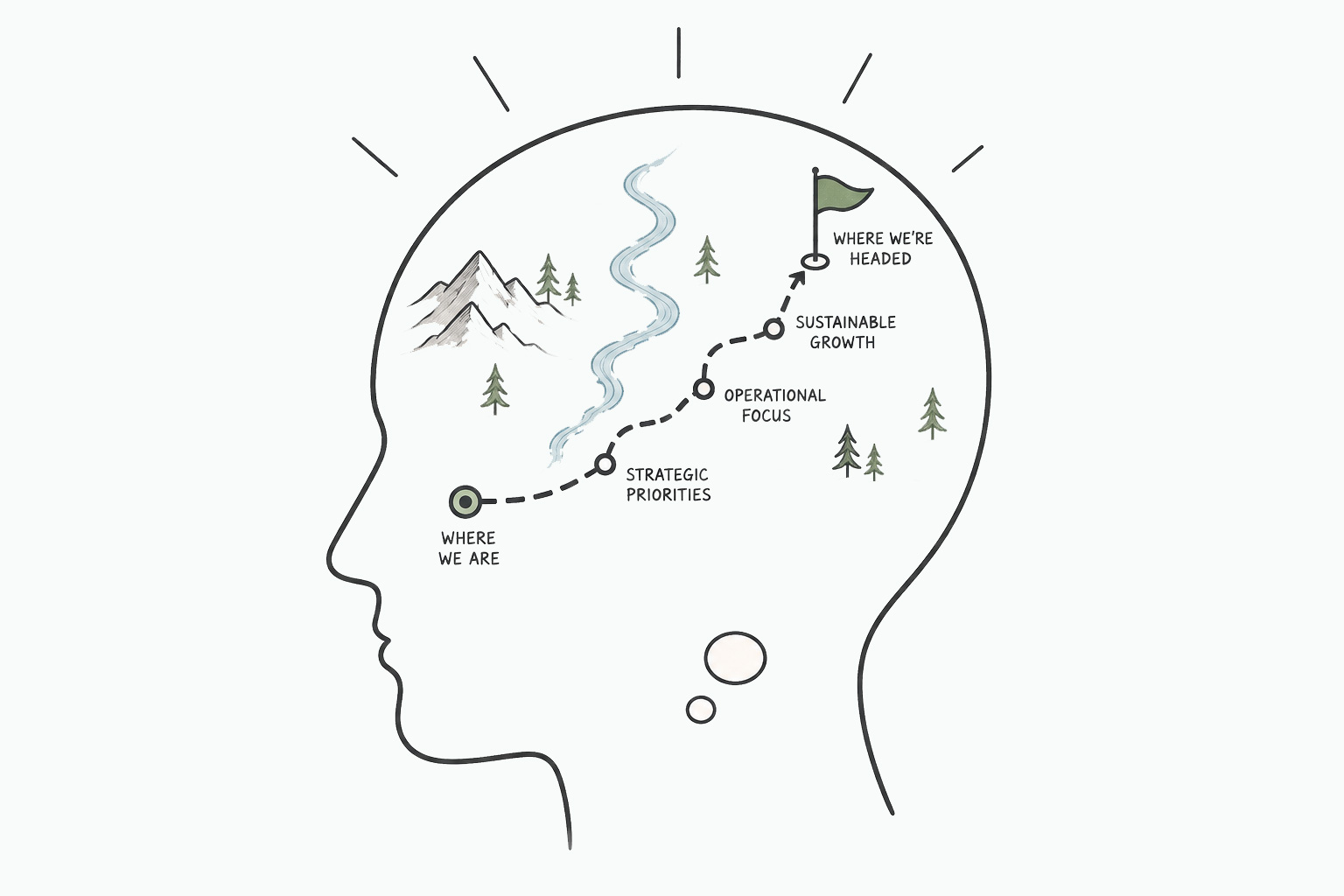
Looking back, it felt a little like climbing aboard a ship with complete confidence in the captain but no map the crew could see. We trusted that we were headed somewhere worthwhile because leadership clearly believed we were. What we didn’t share was a common understanding of the route, and that made it much harder for everyone else to make good decisions along the way.
Once I Saw It, I Couldn’t Unsee It
After that experience, I started noticing the same pattern in company after company. The industries changed, the products changed, and the size of the organizations changed, but the underlying challenge remained remarkably consistent.
Leadership almost always had a strategy. Over time, I stopped wondering whether a strategy existed and started paying attention to whether the rest of the organization understood it well enough to make decisions without constantly relying on leadership to interpret it.
I also heard many of the same conversations regardless of the company. People wondered whether everyone was working toward the same priorities or whether departments were simply staying busy. They questioned whether there was a bigger plan they just hadn’t seen. At the time, I assumed they were asking for more communication from leadership. Looking back, I don’t think that was it at all.
I think they were asking for context. People generally knew what they were expected to do, but they didn’t always understand how their work contributed to the company’s broader growth strategy or how their decisions affected other parts of the organization. Without that context, departments naturally optimized for their own priorities because that was the information they had available. Nobody was doing anything wrong. They were making the best decisions they could with the understanding they’d been given.
Writing Doesn’t Create a Strategy. It Creates Shared Understanding.
For a long time, I assumed the answer was simply to document the strategy. The more companies I worked with, however, the more I realized that writing wasn’t valuable because it created a strategy. It was valuable because it created a shared understanding of one.
Dan and I have experienced this firsthand while building SRGP. We spend a lot of time talking about our business, our clients, and where we want to take the company. Those conversations are incredibly valuable, but we’ve learned that conversation alone isn’t enough. It’s only when one of us starts writing that we discover where we’ve interpreted the same discussion differently. Writing doesn’t create alignment by itself. It reveals whether we’re actually seeing the business the same way by giving us something concrete to react to together.
That’s changed the way we think about documenting strategy. Instead of relying on our memories of what was said, we’re reacting to the same words on the same page. Sometimes we discover we’re aligned. Other times we realize we’ve each been carrying around a different interpretation of the same conversation. Either outcome is valuable because we’ve uncovered something we couldn’t see while we were simply talking.
I’ve come to believe that’s exactly what a growth strategy should do for an organization. It shouldn’t simply preserve what leadership knows. It should give everyone something they can understand, question, refine, and ultimately align around together.
Don’t Wait Until You Get Bigger
Many leaders assume this becomes important once the company reaches 50 or 100 employees. I don’t believe that’s true anymore.
In fact, I think smaller companies have even more to gain because they’re still building the habits that will shape how the organization grows. A growth strategy doesn’t need to be a hundred-page strategic plan or an annual planning document that sits on a shelf. It can be remarkably simple as long as it clearly explains where the company is going, why leadership believes that direction makes sense, and how the organization intends to get there.
More importantly, it should become a living document. As the market changes, customers respond, and the company learns, the strategy should evolve as well. The goal isn’t to create something permanent. The goal is to create something the entire organization can continue reacting to together.
A Different Way to Think About Growth
One of the biggest lessons I’ve learned over the past twenty-five years is that most companies don’t struggle because leadership lacks a growth strategy. Most already have one. The challenge is that too few people share the same understanding of it across the organization.
Eventually, every growing company reaches a point where founders can no longer personally explain every decision, onboard every employee, or answer every question. At that point, conversation alone stops scaling because the strategy exists primarily in the minds of the people who created it. Shared understanding becomes one of the company’s greatest competitive advantages because people throughout the organization can begin making decisions based on the same context rather than their own interpretation of it.
I’ve come to believe that’s one of the most important responsibilities of leadership. The goal isn’t simply to create a growth strategy. The goal is to create a shared understanding of it so that everyone in the organization is working toward the same destination for the same reasons.
Looking back, I don’t think the companies that grew the fastest were the ones with the smartest leaders or even the best strategy. They were the ones where more people understood where the company was going and used that shared understanding to make better decisions every day.
That’s why I believe every company should write its growth strategy down. Not because leadership needs another document, but because the rest of the organization deserves the same shared understanding that leadership already has. When people understand where the company is going and why, they stop making decisions in isolation and start making decisions that move the business in the same direction.
AI is changing the tools. Experience still drives the outcome.

Every technology revolution creates new opportunities - and new distractions. The challenge isn't deciding whether to adopt AI. It's knowing where it creates real competitive advantage, where it introduces risk, and how to use it without sacrificing the quality of your brand or go-to-market strategy.
That's where SRGP comes in. We've spent more than two decades helping B2B companies navigate every major shift in modern marketing - from SEO and digital advertising to marketing automation, CRM, and now AI. Our job isn't to chase the newest technology. It's to understand how each innovation fits into a smarter commercial growth strategy.
If you're looking for experienced operators who are AI-forward, human-led, and focused on measurable growth, we'd love to meet you.
Meet With the Founders